Story by CCS Editor / November 5, 2026
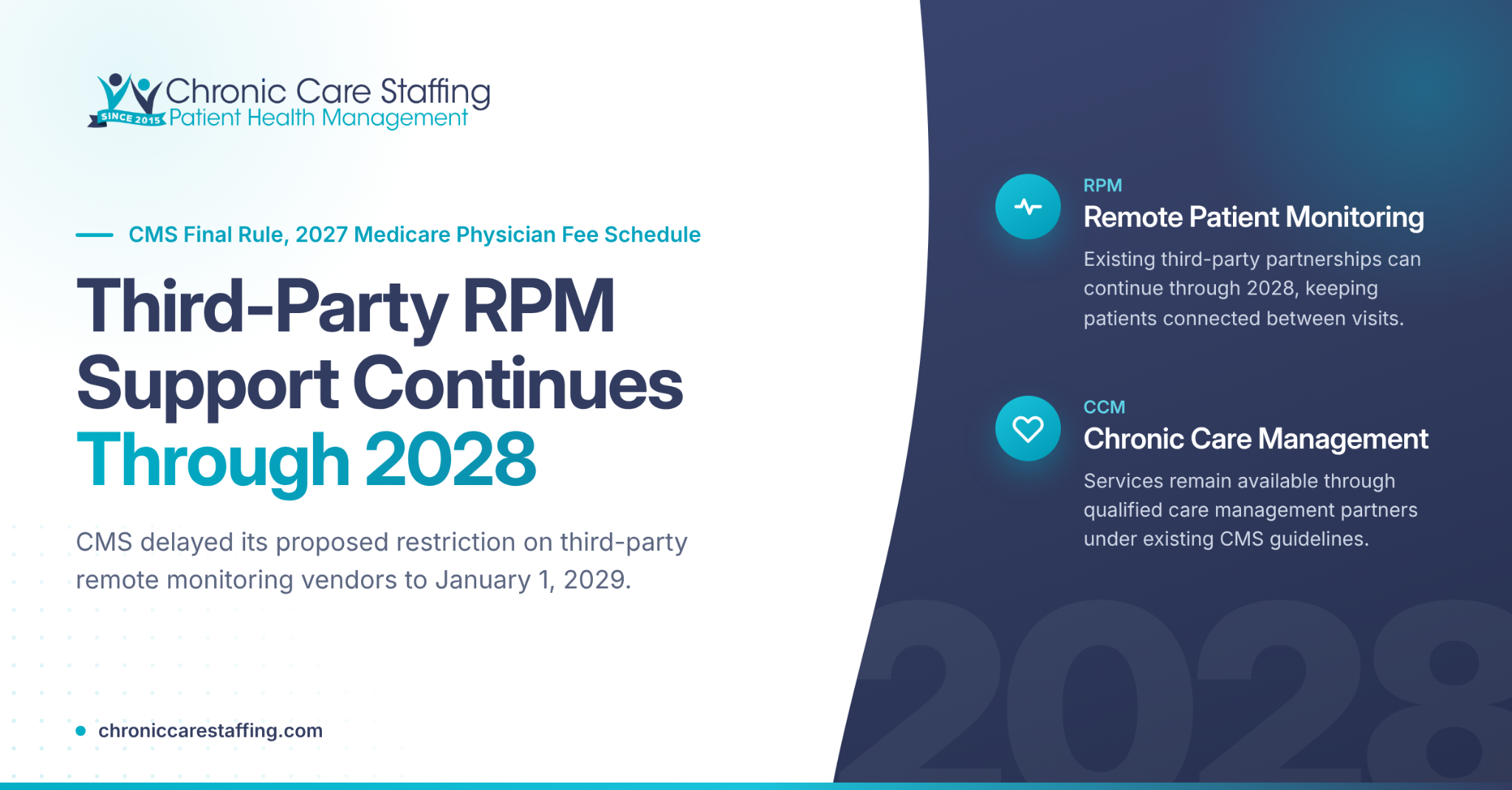
CMS released the CY 2027 Medicare Physician Fee Schedule final rule on November 4, 2026. Practices can keep working with third-party partners for remote patient monitoring (RPM) through 2028, because CMS delayed its requirement that RPM and RTM be furnished only by practice-employed clinical staff to January 1, 2029. Two new remote monitoring rules still take effect January 1, 2027: a separately reportable initiating visit for RPM and RTM, and established patient status for RTM. For chronic care management (CCM), the CMS fact sheet lists no changes to how services are furnished, and CMS calls the prevention and management of chronic disease a top priority.
The Medicare Physician Fee Schedule sets how Medicare Part B pays physicians and other billing practitioners each year. CMS publishes a proposed rule in the summer, takes public comment, and then issues a final rule in the fall. The CY 2027 proposed rule came out July 14, 2026, and the final rule (CMS-1848-F) followed on November 4, 2026. Most of its policies apply to services furnished on or after January 1, 2027.
For care management, the most closely watched part of this rule was remote monitoring. In July, CMS proposed paying for RPM and RTM only when the work is done by clinical staff employed by the billing practice. After considering public comments, CMS kept that requirement and moved its start date to 2029.
CMS proposed four remote monitoring changes for 2027. Here is where each one landed in the final rule:
| Proposal | Final Rule Outcome |
| RTM furnished only to established patients | Finalized for 2027 |
| Separately reportable initiating visit at the start of RPM or RTM | Finalized for 2027 |
| Updated valuation for RPM and RTM services | Finalized for 2027 |
| Payment only when RPM or RTM is performed by practice-employed clinical staff | Delayed to January 1, 2029 |
In the final rule fact sheet, CMS states that it is “delaying for two years, to Jan. 1, 2029, the requirement to only allow payment for RPM or RTM services when performed by clinical staff employed by the practice to provide additional time for practices to adapt to this aspect of the policy.”
CMS also asked for comment on bundling the RPM and RTM CPT codes into four new HCPCS G-codes. It did not adopt that change in this rule and said it may consider the comments in future rulemaking.
Yes. Under the final rule, practices can continue working with third-party partners to furnish RPM and RTM through December 31, 2028. Those services still have to meet the new 2027 requirements, including the initiating visit and, for RTM, established patient status.
The delay is a transition period. CMS kept the employed staff requirement and moved its start date, so practices that rely on outside monitoring support should use 2027 and 2028 to plan how their RPM programs will be staffed once the requirement takes effect in 2029.
CMS placed chronic disease at the center of this year’s rule. The final rule fact sheet notes that three in four American adults have at least one chronic condition and more than half have two or more, and states that “focusing on the prevention and management of chronic disease is a top priority for us.”
The fact sheet does not list any change to how CCM services are furnished or supervised, so CCM continues under existing CMS guidelines heading into 2027. CCM payment amounts will still reflect the 2027 conversion factor and the practice expense updates in the rule. The policies CMS did finalize add support for coordinated, team-based care of chronic and behavioral health conditions:
CMS also asked for comment on redesigning primary care payment, including how technology fits into primary care and prospective primary care payment, and said it will consider that feedback in future rulemaking.
Our licensed nurses and care coordinators run chronic care management, remote patient monitoring, and virtual clinical programs inside your EMR, working as an extension of your practice. We are following this rule closely and will keep working with our partners to plan for the changes coming in 2027 and 2029, so their patients keep getting consistent care between office visits.
Want to see how the 2027 final rule affects your care management services? Book a consultation for a 30 minute call with our clinical team, or call us at (888) 254-4435.
When was the CY 2027 Physician Fee Schedule final rule released?
CMS released the final rule on November 4, 2026. Most of its policies take effect January 1, 2027.
Did CMS ban third-party RPM vendors?
Not for 2027. CMS delayed its requirement that RPM and RTM be performed only by practice-employed clinical staff to January 1, 2029, so third-party partners can continue supporting these services through 2028.
What new RPM and RTM rules start in 2027?
Starting January 1, 2027, practitioners billing RPM or RTM must furnish a separately reportable initiating visit at the start of services, and RTM can only be furnished to established patients. CMS also finalized updated valuation for these services.
Does the 2027 final rule change chronic care management?
The CMS fact sheet lists no changes to how CCM is furnished or supervised, so CCM continues under existing CMS guidelines. Payment amounts will reflect the 2027 conversion factor, and CMS states that the prevention and management of chronic disease is a top priority.
Did CMS finalize new RPM G-codes?
No. CMS asked for comment on bundling RPM and RTM codes into four new G-codes and said it may consider that feedback in future rulemaking.

