Story by Connor Danielowski / December 18, 2025

Story by Connor Danielowski / December 2025
Every primary care practice focuses on patient acquisition, but the real determinant of long-term success is patient retention. Loyal patients follow treatment plans, communicate openly, trust their providers, and generate predictable recurring revenue.
But here’s the truth:
Your ability to retain a patient isn’t determined during the appointment-it’s determined during the weeks between them.
Patients navigate the overwhelming majority of their health journey on their own, often while juggling:

If no one is checking in on them during this time, engagement drops, outcomes worsen, and patients begin exploring other practices that offer more support.
This is exactly the care gap Chronic Care Management (CCM) was designed to close.
And when that gap closes?
Patient retention rises-dramatically.
Patients stay with practices that make them feel:
CCM turns that feeling into a structured care model, consistently reinforcing patient trust month after month.
Below is how CCM transforms between-visit care into one of the strongest patient retention engines in modern primary care.
A patient who hears from their practice once or twice a year feels like a number.
A patient who hears from their care team every month feels like a priority.
CCM provides:
This ongoing human connection builds a relationship that patients are unlikely to abandon.
Retention thrives when communication increases-and CCM guarantees it.

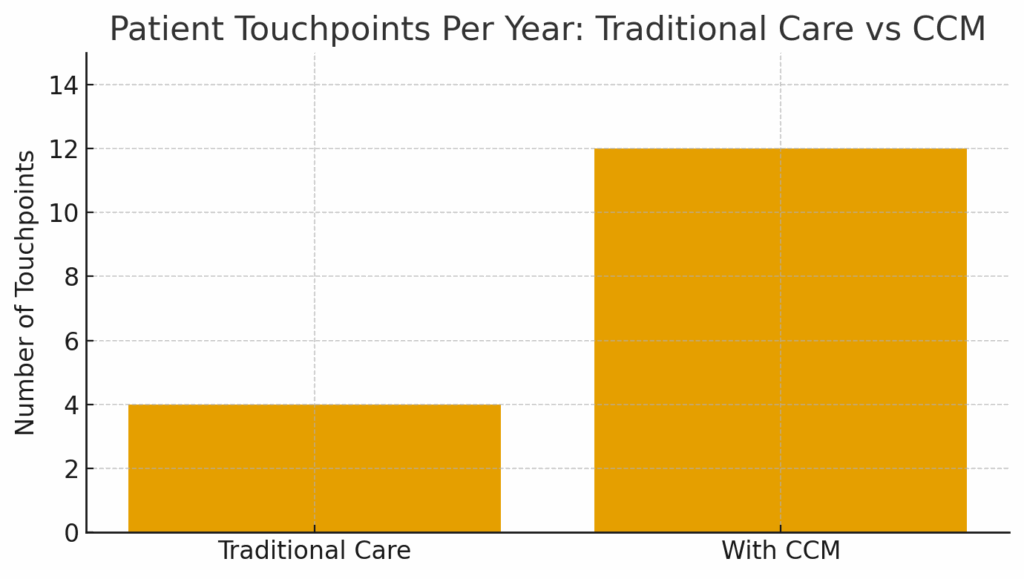
Traditional primary care offers 2–4 touchpoints per year.
CCM increases that to 12–15+ meaningful interactions annually.
With every monthly call, patients:
You cannot buy that level of loyalty through marketing.
CCM creates it.

Patients don’t switch providers because they’re unhappy with medical care.
They switch because no one helped them when they needed it most.
Barriers that cause disengagement include:
CCM care managers identify and solve these issues before they damage the provider–patient relationship.
A patient who receives help during a crisis becomes a loyal patient for life.
Patients who understand their conditions are more engaged.
Engaged patients stay with your practice.
Monthly CCM communication:
When patients feel informed rather than overwhelmed, they trust their provider more deeply.
And trust is the foundation of retention.
When patients don’t know who to call, they call urgent care-or they switch providers.
CCM solves that through:
This availability is a massive retention driver.
The practice that is always reachable is the practice patients never leave.


Patients who avoid hospital visits attribute that success to their care team.
CCM reduces:
When patients feel healthier because of your care model, they remain patients for years-not months.
Patients enrolled in CCM experience fewer costly healthcare events, and many see meaningful reductions in out-of-pocket expenses.
Financial relief + improved health = unwavering loyalty.
Patients don’t leave the provider who saves them money.
Disjointed care causes:
CCM bridges communication across specialists and healthcare systems, ensuring that patients feel protected and guided instead of lost in the system.
Happy, informed patients stay with their provider.
Chronic disease is emotionally heavy.
Many patients-especially seniors-battle:
Monthly CCM calls provide emotional relief, compassionate listening, and reassurance.
When patients feel cared for, they don’t leave.

CCM isn’t just a billing program.
It’s a relationship-building engine that strengthens the bond between patients and providers through consistent, meaningful engagement.
It:
And ultimately…
CCM keeps patients connected to the practice that cares for them.
Patient retention is not won during an annual appointment-it’s won through the ongoing support CCM provides throughout the year.
When you close the care gap, you increase:
CCM helps your practice keep the patients you worked so hard to acquire.

