The 3-Month Ramp-Up: How Clinics See New Revenue Flow Within a Quarter of Launching CCM

Story by Connor Danielowski / January 6, 2026

Launching a Chronic Care Management (CCM) program often comes with one big question:

How long before this actually generates revenue?

The ROI of Chronic Care Management

For most clinics, the answer is clear and consistent: within 30 days of going live.

When CCM is implemented correctly, with compliant workflows, patient engagement, and operational support, clinics typically begin seeing meaningful, recurring revenue within the first three months. This period is known as the CCM ramp-up, and understanding what happens during each phase helps set accurate expectations and ensures long-term success.

Below is a realistic look at how clinics move from launch to revenue within a single quarter.


Month 1: Program Setup and Patient Enrollment

The ROI of Chronic Care Management

The first month focuses on building the foundation. While revenue is not the primary outcome during this phase, it is where future reimbursement is unlocked.

What Happens in Month 1

  • Identification of CCM-eligible Medicare and Medicare Advantage patients (two or more chronic conditions)
  • CCM consent workflows established and documented
  • Care plan templates finalized and aligned with CMS requirements
  • Clinical staff and care coordinators trained on CCM processes
  • Initial patient outreach and education begins

Most clinics start by enrolling 20–40% of their eligible population in the first month. This is intentional, rushing enrollment often leads to documentation gaps or patient confusion.

Revenue Expectations

  • Partial billing may begin late in the month
  • Most clinics do not see full reimbursement yet
  • The real value of Month 1 is compliance readiness and scalability

Key takeaway: Month 1 sets up predictable revenue, even if cash flow hasn’t fully started yet.

Month 2: Active CCM Delivery and First Meaningful Reimbursement

Month 2 is where CCM shifts from setup to execution.

Patients are now actively receiving:

  • Monthly care coordination
  • Medication reconciliation
  • Preventive care reminders
  • Chronic condition monitoring and follow-ups

Care teams are consistently documenting time spent, which is critical for billing compliance.

What Changes in Month 2

  • Most enrolled patients reach the CMS-required 20 minutes per month
  • CPT 99490 billing becomes consistent
  • Add-on codes may begin applying for higher-acuity patients
  • Providers gain confidence in workflows and reporting

Revenue Expectations

For a clinic with 100 enrolled CCM patients:

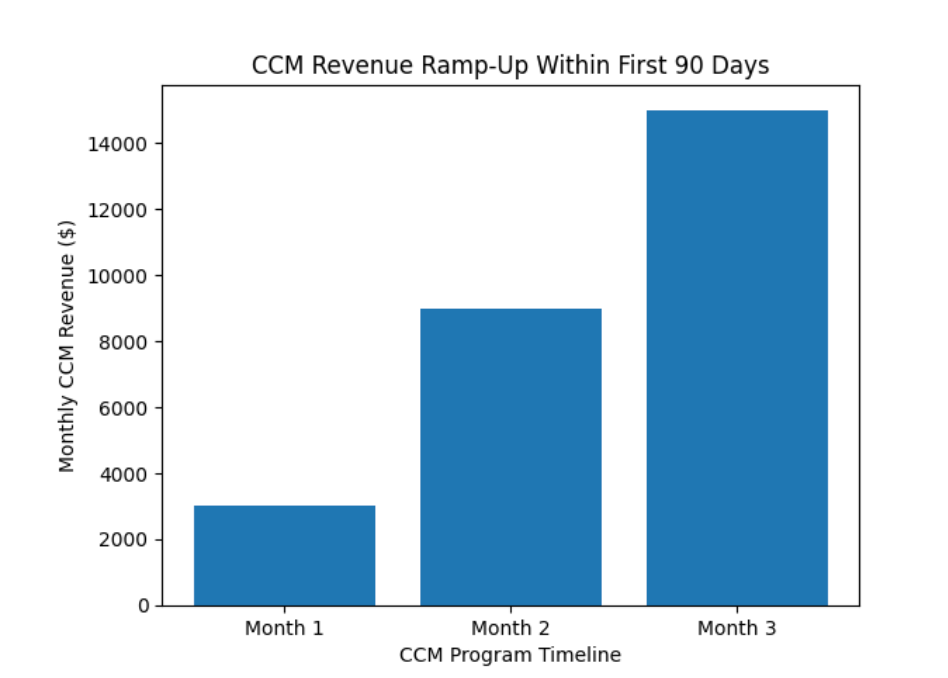
  • Base CCM revenue can reach $5,500–$6,500 per month
  • Early add-on codes may increase totals further
  • Revenue is now recurring, not one-time

Key takeaway: Month 2 is typically the first month clinics feel the financial impact of CCM.

Build a Model of Recurring Revenue Growth with Chronic Care Management


Month 3: Optimization, Scale, and Predictable Cash Flow

Building Audit Proof CCM Programs

By Month 3, CCM becomes operationally routine, and financially reliable.

At this point:

  • Enrollment processes are refined
  • Patient engagement improves
  • Care teams operate at full efficiency
  • Reporting and billing cycles stabilize

Clinics often expand enrollment further once they see consistent results.

What Happens in Month 3

  • Enrollment increases to 50–70% of eligible patients
  • Add-on CCM codes (complex CCM, additional time) are captured accurately
  • Providers experience reduced administrative burden
  • CCM revenue integrates into monthly financial forecasting

Revenue Expectations

Using conservative estimates:

  • 150 enrolled patients × ~$60 = $9,000/month
  • Add-on codes can increase totals by $2,000–$5,000/month
  • Annualized CCM revenue now exceeds $130,000–$170,000

Key takeaway: By the end of Month 3, CCM is no longer an experiment, it’s a dependable revenue stream.


Why CCM Reaches Profitability So Quickly

Chronic Care Management reimbursement. How Providers Can Maximize Revenue

CCM ramps faster than many clinical programs because:

  • CMS reimbursement is monthly and recurring
  • Patient eligibility is already present in most practices
  • No new clinical visits are required
  • Care is delivered remotely and asynchronously
  • Staffing and workflows can be outsourced or supported

When paired with experienced CCM partners, clinics avoid the most common delays:

  • Documentation errors
  • Inconsistent patient engagement
  • Missed billing opportunities
  • Staff burnout

What This Means for Clinics Considering CCM

If your clinic has not yet implemented CCM, it’s important to understand that waiting also has a cost.

Every month without CCM means:

  • Eligible patients going unsupported
  • Revenue left unclaimed
  • Missed opportunities to improve outcomes and retention

Clinics that launch CCM today are often surprised by how quickly it integrates into daily operations, and how fast it begins contributing financially.


CCM Is a 90-Day Investment With Long-Term Returns

The 3-month ramp-up is not a barrier, it’s a runway.

Within one quarter, clinics typically move from planning to predictable, compliant revenue while simultaneously improving patient engagement and care coordination.

With the right infrastructure and support, CCM becomes one of the most sustainable programs a clinic can offer, clinically and financially.


Chronic Care Staffing Team
 
Chronic Care
Management Benefits
Outsourcing Chronic
Care Management
Improve
Patient Care
Generate Greater
Practice Revenue
Remote
Patient Monitoring
Highly Qualified
Care Coordinators
What is Chronic
Care Management?
Who is Eligible for Chronic
Care Management?
